
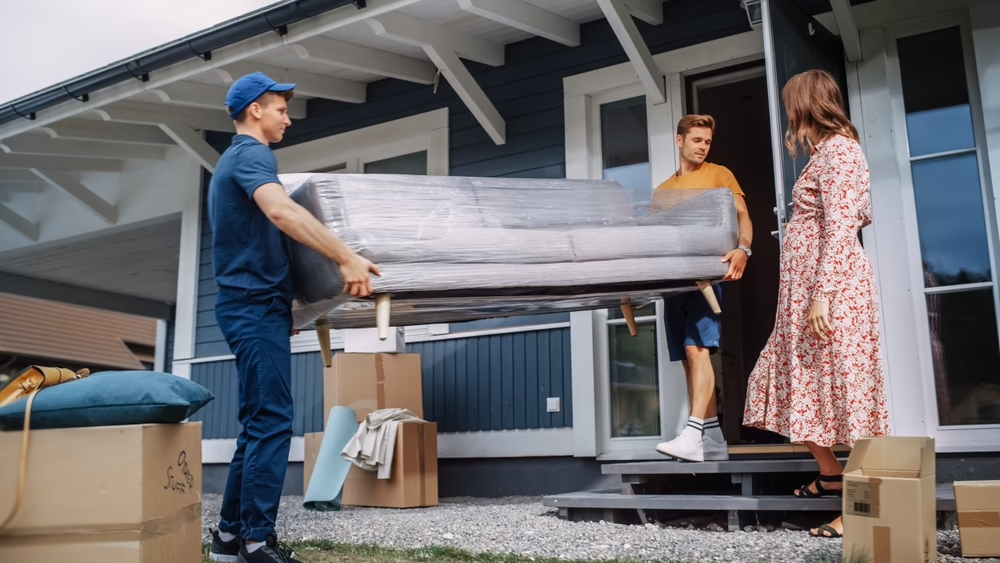
Getting out of a rental house quickly becomes a race against time. From putting away the last box to scrubbing the baseboards, most tenants’ eyes are on reaching the “finish line.” The biggest risk to your security deposit, however, does not lie in how clean you manage to make your microwave; instead, it lies in the injuries caused to the walls while hurriedly maneuvering furniture inside the tiny gaps. Even if living inside the apartment results in little scratches here and there, moving furniture inside it will result in significant injuries to the walls.
Often landlords and tenants will disagree over these marks at the end of the final walk-through. You might think you have a “simple scrape,” which you intended to brush off, while the landlord thinks that you’ve left him with a deep gash that will need to be sanded, filled, and repainted corner to corner. In order to keep your financial record clean, you need to know how furniture damages drywall.
The Physics of Moving-Day Damage
Unlike the slow fading of paint caused by UV rays, moving-day damage is high-impact and mechanical. Drywall (or sheetrock) is essentially a chalky gypsum core sandwiched between two layers of heavy paper.This product is very resistant when subjected to even forces but becomes extremely vulnerable when faced with impact, like the corner of a bookshelf or the metal leg of a bed frame.
The key to establishing whether you will find yourself reaching into your wallet after the last of the boxes has been unloaded lies in understanding how your furniture interacted with the wall surface. There are three main types of collisions that may take place during a relocation process:
1. Corner Crushing
Perhaps one of the most frequent injuries that can occur when moving is the “corner crushing.” When an object such as a couch or bureau is moved around a corner at a door or in a narrow hallway, the person who is inside the move will lose their leverage. The weight will change, and the corner of the furniture will crush the metal or plastic corner bead under the drywall mud. It cannot be fixed by merely repainting, but it needs to be remade.
2. The “Keying” Effect
Prominent fixtures may be a silent death warrant to any wall. For example, a drawer handle, a metal bed fixture, or even the bottom edge of a wooden desk functions like a dagger slicing into the delicate paper of the drywall. Should the mover trip or lose balance, that one prominent bolt would make a long, continuous groove down the entire length of the hallway. This type of long groove is challenging to conceal seamlessly because it spans over multiple studs within the wall.
3. Leverage Piercing
This happens when a long, vertical object,like a floor lamp, a tall headboard, or a rolled-up rug, is tilted to get through a door. The lower part serves as a pivot point, and even if the upper part deviates slightly, it will be able to pierce the sheetrock at the precise point where the tool strikes it. The longer the tool, the more power is transferred to it, and it requires minimal effort to make a “punch through,” which requires mending with a mesh patch.
Hiring a professional moving company in Haddonfield is often a strategic financial move. These experts utilize specific “shimming” and “tipping” techniques to keep the center of gravity stable, preventing the furniture from swinging into the wall’s surface in the first place.
Identifying Furniture Strikes vs. Normal Wear
Most standard rental laws prevent the “aging” but not the “impacts” that can occur within your rental unit. You should understand the difference prior to any confrontation with your landlord.
| Type of Mark | Classification | Responsibility | Repair Difficulty |
| Faint Chair Rub | Normal Wear | Landlord | Very Low |
| Dust Shadows | Normal Wear | Landlord | Low (Cleaning) |
| Compressed Drywall | Damage | Tenant | Medium (Spackle) |
| Corner Bead Crush | Damage | Tenant | High (Mudding) |
| Hardware Gouge | Damage | Tenant | Medium (Patching) |
The property managers tend to regard paint deterioration as one of the routine costs of running an establishment. However, the appearance of “holes” and “craters” is treated as a discretionary cost. For example, the hole created by the furniture leg cannot be considered an expense on paint, but the expense on repairing it will involve several hours of work.
The High Cost of the “DIY” Slip-Up
When tenants choose to move the three-piece section on their own to reduce costs, they end up using the saved money to repair their furniture. With heavier furniture, there is no way one can act fast once it tips over. When a 200-pound dresser starts tipping towards the wall, the average human being cannot prevent it without hurting themselves.
Coordinating with movers in Cherry Hill provides the logistical support required to manage these clearance issues. Professionals use “door jam protectors”, spring-loaded pads that clip onto the frame, and heavy-duty moving blankets. These blankets aren’t just for the furniture; they act as a “soft bumper” for the house. If a blanketed sofa bumps a wall, the impact is spread across a wide area, resulting in a harmless rub rather than a structural puncture.
Stellar Movers use these protective measures as a standard part of their process, recognizing that protecting the home is just as important as protecting the belongings inside it.
Your Wall-Protection Checklist for Moving Day
Before the first piece of furniture leaves the room, follow this list to minimize the risk of losing your security deposit:
- Remove All Hardware: Unscrew sofa legs, take off drawer pulls, and remove any decorative finials. Those extra two or three inches are usually the difference between a clean exit and a ruined door frame.
- Clear the Path: Don’t try to navigate around “small” items. Move every box, rug, and trash can out of the way before attempting to move large furniture.
- Use the “High-Low” Carry: When moving a long item like a couch through a hallway, one person should carry their end high while the other carries low. This tilts the piece at an angle that often provides better clearance for the walls.
- Melamine Sponge First: Before you assume a mark is a permanent gouge, try a Magic Eraser. Many furniture “scuffs” are actually just surface transfers of wood stain or rubber that will wipe away with minimal effort.
- Padding the “Impact Zones”: Identify the tightest corner in your home and tape a piece of flattened cardboard over the wall corner. If the furniture hits the cardboard, the wall stays safe.
When to Call in the Professionals
The move to a new home involves many moving parts, and the most stressful part is often the fear of damaging the property you are trying to leave. The risk factor will skyrocket if you have any antique furniture or heavy solid wood stuff or if you are moving out of a multi-story building with small stairways.
Stellar Movers understands the mechanics of space and leverage. By using professional-grade equipment like floor runners and specialized dollies, all heavy lifting remains controllable, which eliminates the possibility of accidental damages that can result in a reduced security deposit.
If a collision does happen during your DIY move, don’t ignore it. Applying a bit of lightweight spackle and sanding it flush is a cheap fix that can save you hundreds of dollars in “administrative repair fees” from a landlord. However, the best strategy is always prevention. By treating the walls of your rental as a fragile “envelope” and padding your furniture accordingly, you can walk away from your old home with your finances intact.
Stellar Movers handles every item with the goal of keeping both your furniture and your apartment’s infrastructure in original condition. Whether you are moving across town or across the state, Stellar Movers provides the expertise needed to navigate tight spaces without a scratch. Contact us today to schedule your next move!